Driving Efficiency: Micro-LED Backlights Revolutionize EV Dashboards
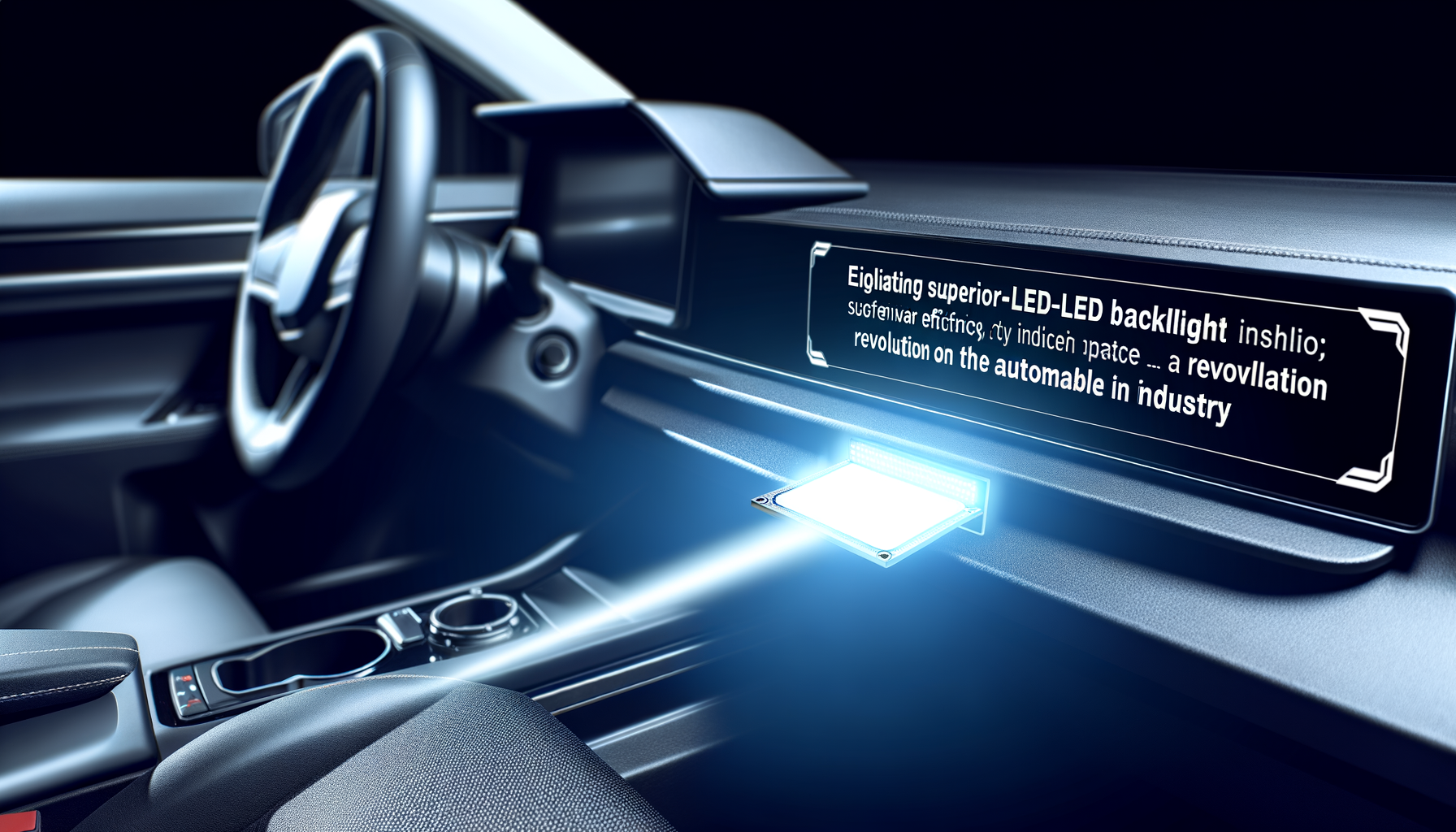
Electric vehicles (EVs) have rapidly evolved from niche eco-friendly novelties into mainstream mobility solutions, driven by ever-increasing consumer demand, tighter emissions regulations, and continuous battery technology improvements. As EVs become more sophisticated, their in-cabin user experiences evolve too, featuring vibrant displays, advanced infotainment systems, and interactive digital dashboards. However, these electronic upgrades come with one critical challenge: power consumption.
Dashboard backlighting systems, though often overlooked, are essential components that ensure display readability under varying lighting conditions. Conventional LED backlighting solutions can consume significant power, impacting overall efficiency and range-key metrics for EV owners and manufacturers alike. In this context, the integration of low-power micro-LEDs into light guide plates (LGPs) emerges as a game-changing innovation. By combining the ultra-high efficiency of micro-LED sources with optimized light distribution via LGPs, EV designers can achieve crisp, uniform backlighting while minimizing energy draw and extending driving range.
This article delves into the technological underpinnings, design considerations, and real-world benefits of micro-LED-integrated LGP backlighting solutions for electric vehicle dashboards. We’ll explore why this approach outperforms conventional methods, outline best practices for implementation, and examine how leading OEMs are already leveraging this technology to differentiate their EV offerings.
Why Dashboard Backlighting Matters for EV Efficiency
Electric vehicles rely on battery reserves not only to power propulsion but also to feed myriad electronics-from climate control to advanced driver-assistance systems (ADAS). Every milliamp drawn by dashboard lighting is a milliamp unavailable for range extension. Traditional surface-mount LEDs, although reliable and cost-effective, suffer from relatively high forward voltage requirements and inefficiencies when illuminating large-area displays uniformly.
Key pain points include:
Power Draw: Standard white LEDs typically operate at 2-3V and draw tens of milliamps each. In a dashboard backlight array with dozens of LEDs, cumulative consumption can exceed half a watt just for illumination.
Thermal Management: Higher power LEDs generate heat, necessitating robust thermal paths and sometimes active cooling-adding weight and complexity.
Uniformity Challenges: Conventional LEDs mounted at module edges can create hot spots and bright edges unless the LGP is meticulously designed with micro-structures to scatter light evenly.
Space Constraints: As dashboards grow more compact and clutter-free, designers need thinner backlighting units that still deliver high luminance.
Transitioning to micro-LED-based solutions directly addresses these issues by leveraging the miniaturization, efficiency, and direct-emission benefits of micro-LED arrays.
Understanding Micro-LEDs and Light Guide Plates
Micro-LEDs are inorganic light sources fabricated using semiconductor processes that yield devices measuring just a few micrometers per side. Their small size confers several advantages:
• Ultra-High Efficiency: Micro-LEDs boast external quantum efficiencies (EQE) exceeding 70%, far higher than conventional LEDs. • High Brightness: They can operate at peak luminance levels unmatched by OLED or traditional LED counterparts. • Fast Response: Sub-µs switching speeds enable dynamic brightness control and potential for adaptive lighting techniques. • Long Lifetime: Inorganic micro-LEDs exhibit minimal burn-in and long operational lifespans.
Light guide plates are optical films-typically acrylic or polycarbonate-engineered with micro-structures (dots, lines, or prisms) that extract light injected at one or more edges and distribute it across a planar surface. When paired with conventional LEDs, LGPs often require diffuser layers and multiple optical films to smooth out artifacts and achieve uniformity.
Integrating micro-LEDs directly onto or adjacent to LGPs allows for:
– Reduced optical path losses
– Elimination of some diffuser films
– More precise control over local luminance profiles
– Lower overall power consumption
Design Considerations for Micro-LED-Integrated LGPs
- Optical Simulation and LGP Patterning Advanced ray-tracing and finite-difference time-domain (FDTD) simulations are essential to model how micro-LED arrays will couple light into the LGP. Key parameters include:
• Injection Angle: Micro-LEDs can inject light at narrow angular distributions-designing microstructures that capitalize on this can minimize total internal reflection losses. • Dot/Prism Geometry: The size, shape, and spatial density of extraction features determine uniformity and brightness gradients. • Surface Treatments: Anti-glare coatings and micro-textures on the LGP surface can modulate reflection and scattering for optimal readability.
Micro-LED Driver Electronics Efficient low-voltage driver ICs must be matched to the micro-LED’s forward voltage characteristics (often around 2.5-3V for white micro-LEDs). Pulse-width modulation (PWM) techniques enable dynamic dimming, while advanced pulse-amplitude modulation (PAM) can optimize luminous efficacy at different brightness levels.
Thermal Management Though micro-LEDs generate less heat per lumen than conventional LEDs, the densely packed arrays in LGP applications still require careful thermal pathway design. Options include:
• Embedded Micro-Heatsinks: Thin metal or graphene layers within or behind the LGP. • High-Thermal-Conductivity Substrates: Advanced polycarbonate blends or glass substrates infused with thermal fillers. • Passive Convection Channels: Micro-channels integrated into dashboard housings that facilitate airflow.
- Mechanical Integration and Assembly Space constraints in modern EV dashboards demand ultra-thin profiles. Techniques to minimize thickness include:
• Chip-On-Film (COF) Packaging: Micro-LED arrays bonded directly onto flexible printed circuit boards (PCBs) that wrap around or attach to the LGP edge. • Flip-Chip Bonding: Micro-LEDs flipped and bonded to driver substrates without bulky wire bonds. • Wafer-Level Optics: Micro-lenses formed during wafer processing to collimate light before coupling to the LGP.
- Electrical Routing and EMC With high-frequency PWM or PAM in play, electromagnetic compatibility (EMC) becomes crucial. Shielding strategies and multi-layer PCBs can isolate sensitive ADAS or infotainment electronics from backlight drivers.
Benefits and Performance Metrics
By integrating micro-LEDs with optimized LGP designs, EV manufacturers can achieve:
• Power Reduction: Up to 50-70% lower backlight power consumption compared to conventional LED arrays, translating to measurable EV range gains. • Enhanced Brightness Uniformity: Luminance variations below 5% across the dashboard surface, improving readability under direct sunlight. • Ultra-Thin Profiles: Backlight modules as thin as 1.5 mm, enabling sleeker dashboard designs. • Dynamic Dimming: Millisecond-level response enables features like adaptive lighting that adjusts backlight intensity based on ambient conditions or driving modes.
Real-World Implementation: A Case Study
Consider EVBrand, a leading electric vehicle OEM that recently introduced a flagship EV with a fully digital, wraparound dashboard. By partnering with OptiBright Technologies, they integrated micro-LED arrays along the top and bottom edges of a custom-etched LGP. The results were transformative:
• Power Consumption: Reduced from 1.2 W to 0.4 W under standard brightness settings-a 67% savings. • Range Impact: Estimated additional 3-5 miles of driving range per full charge, purely from backlight efficiency gains. • Thickness: Achieved a full display stack thickness of 5 mm, enabling a continuous, curved display surface without bulky housings. • User Feedback: Improved perceived brightness and clarity, even during dawn/dusk light transitions.
These metrics underscore how micro-LED-LGP integration not only enhances user experience but also delivers tangible EV performance benefits.
Future Trends and Opportunities
Flexible and Foldable Dashboards With the advent of flexible substrates, micro-LED-integrated LGPs could conform to curved or foldable surfaces, enabling wraparound dashboards and center consoles that seamlessly integrate with vehicle interiors.
Smart Backlighting Systems Combining micro-LED backlights with in-cabin sensors (light, driver attention, gesture recognition) can foster adaptive lighting schemes-dimmed at night for reduced eye strain, or accentuated under warning alerts for enhanced safety messaging.
Color-Tunable Displays By leveraging RGB micro-LED subpixels within the LGP framework, dashboards could transition from white backlighting to full-color ambient lighting scenes, heightening brand differentiation and user personalization.
Sustainable Manufacturing Emerging eco-friendly LGP materials and low-temperature assembly processes reduce the carbon footprint of backlight production, aligning with automotive industry sustainability goals.
Best Practices for OEMs and Tier-1 Suppliers
• Start Early with Co-Design: Involve optical engineers, electronics experts, and user-experience designers from the initial concept phase to optimize system-level performance.
• Leverage Simulation Tools: Invest in advanced ray-tracing and thermal modeling software to iterate on LGP microstructures and micro-LED placement before committing to tooling.
• Prioritize Driver Efficiency: Select driver ICs capable of high-frequency modulation with minimal switching losses to maximize overall backlight efficacy.
• Validate Under Real-World Conditions: Conduct in-cabin daylight tests, thermal cycling, and EMC/EMI compliance evaluations to ensure robustness.
• Plan for Scalability: Design modular backlight units that can be adapted across multiple vehicle models to amortize development costs.
Conclusion
As electric vehicles continue to redefine the automotive landscape, every system-level innovation that conserves battery power and enhances user experience represents a competitive advantage. The marriage of micro-LED backlighting with precision-engineered light guide plates offers EV designers a low-power, ultra-thin, and high-uniformity backlight solution that directly contributes to extended driving range and superior in-cabin comfort.
By embracing micro-LED-LGP integration now, OEMs and Tier-1 suppliers can future-proof their dashboard backlighting strategies, differentiate their brands, and meet the ever-tightening efficiency and sustainability targets shaping the next generation of electric vehicles. The road ahead is bright-and remarkably energy-efficient.
Ready to explore how micro-LED backlights with advanced LGPs can transform your next EV project? Reach out to our team of optical and electronics specialists to start your design journey today.
Explore Comprehensive Market Analysis of Light Guide Plate for Vehicle Industrial Control Market
SOURCE -- @360iResearch